
Google Forms is built to collect answers. greetform is built to act on them.
Google Forms describes itself as a tool to create surveys, quizzes, and forms, then analyze responses in real time or send them to a spreadsheet. That is the right job for a lot of use cases. It is not built around continuing a newsletter subscription while the reader is still paying attention.
What Google Forms does well
- Fast to build, free, and familiar to almost every reader.
- Branching through "go to section based on answer," limited to Multiple Choice and Dropdown question types.
- Responses viewable as a Summary, an Individual view, or synced live to a Google Sheet, with CSV export.
- Basic theme customization: color, a header image, and a limited set of built-in fonts.
Where Google Forms stops for a newsletter
Google Forms has no documented newsletter or subscriber-management feature. Collected emails have to move somewhere else, typically Sheets, then a third-party automation layer, before they can reach an ESP or CRM. Branching is also limited to two question types, which restricts how far a newsletter operator can take conditional logic before hitting the tool's ceiling.
What greetform is built for
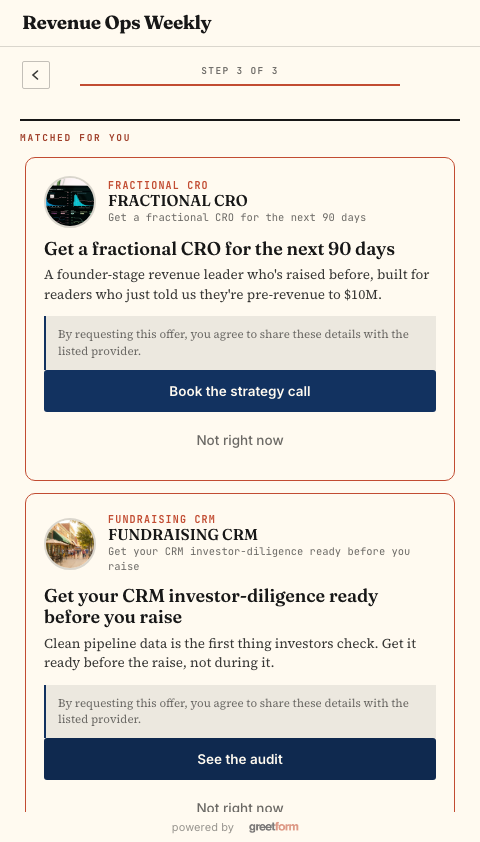
greetform sits after the newsletter subscription already succeeded, asks a short conditional survey built for newsletter segmentation, and immediately uses the answer: a different next question, a relevant offer, a routed lead, or a synced ESP field.
- 01
Ask
A short, optional set of questions built for newsletter segmentation, not generic survey logic.
- 02
Branch
The answer decides the next question or the eligible offer, without the two-question-type ceiling of a general survey tool.
- 03
Route
A relevant offer, membership, or advertiser lead page appears, tied to what the subscriber actually said.
- 04
Sync
The fields that matter reach the newsletter's existing ESP, instead of sitting in a spreadsheet.
The practical decision table
| Your main job | Better starting point | Why |
|---|---|---|
| A quick internal survey or reader poll | Google Forms | Free, fast, and familiar, with no setup beyond the form itself. |
| Newsletter post-subscribe survey and offer routing | greetform | Built specifically for the newsletter moment, with branching that isn't limited to two question types. |
| Branching logic across many question types | greetform | Not restricted to Multiple Choice and Dropdown like Google Forms' section-based branching. |
| Getting an answer into your ESP automatically | greetform | Syncs relevant fields directly, without a separate Sheets-to-ESP automation step. |
| Annual reader research alongside a newsletter | Both | Google Forms for broad one-off research, greetform for the ongoing post-subscribe flow. |
Scenario: a city newsletter separates research from activation
A city arts newsletter might run an annual Google Forms survey about venues and coverage priorities, a good fit since the goal is reviewing responses later. After a new subscribe, the same publisher can use greetform for a shorter continuation: ask which neighborhood matters, then route the reader toward a matching guide, membership, or local advertiser lead, while attention is still high.