

greetform vs Jotform: form builder or newsletter post-subscribe layer?
Jotform is a general-purpose form builder. greetform is a newsletter-specific post-subscribe survey, offer, and lead system. A practical comparison for newsletter operators.
 TJ LarkinBuilds greetform at 8th replayAugust 26, 2026 · 7 min read

- Jotform is a general-purpose form and workflow platform. Its own materials describe data collection, tables, workflow automation, e-signatures, and AI tools, not a newsletter-specific product.
- Jotform has no dedicated post-subscribe layer. Its newsletter material is signup-form templates that capture an email, plus integrations that push submissions into Beehiiv or Mailchimp as subscribers.
- greetform is built specifically for the moment after a newsletter subscribe: conditional questions, an offer wall, lead capture, and routing, not general form building.
- Jotform's conditional logic can show or hide fields and skip pages. greetform's conditional logic is purpose-built for newsletter segmentation, offer eligibility, and ESP field sync.
Pick Jotform when you need a flexible, general-purpose form: applications, registrations, payments, signatures, or file uploads for any part of the business. Pick greetform when the job is specifically what happens right after someone subscribes to your newsletter: a short conditional survey, a relevant offer, and a routed lead, built for that one moment instead of general form collection.
The real question isn't which form builder is better
Jotform and greetform can both ask a question and branch on the answer. That surface similarity misses the point. Jotform is a general-purpose form and workflow platform used for applications, registrations, payments, and internal processes across an entire business. greetform is built around one specific moment: what happens right after someone subscribes to a newsletter.
What Jotform is built for
Jotform describes itself as spanning data collection, Jotform Tables, workflow automation, document automation, e-signatures, an app and store builder, and AI-powered form creation. Its conditional logic, called "Conditional Logic" in the builder, can show or hide a field, skip to a page, update or calculate a field, change the thank-you page, or send an email based on an answer.
- A large template library across applications, registrations, orders, and surveys.
- Payments, e-signatures, and file uploads built into the same form.
- Show/hide, skip-to-page, and calculation-based conditional logic.
- 150-plus business integrations and an AI form and app builder.
Where Jotform stops for a newsletter
Jotform's newsletter material is a signup-form template: build the form, collect the email, receive the submission in Jotform Tables. It has a native Beehiiv integration that adds new submissions as subscribers, and a confirmed Mailchimp integration for lead capture into a list. Neither goes further than moving a new subscriber's email into the ESP. There is no documented layer for what happens to that subscriber next.
What greetform is built for
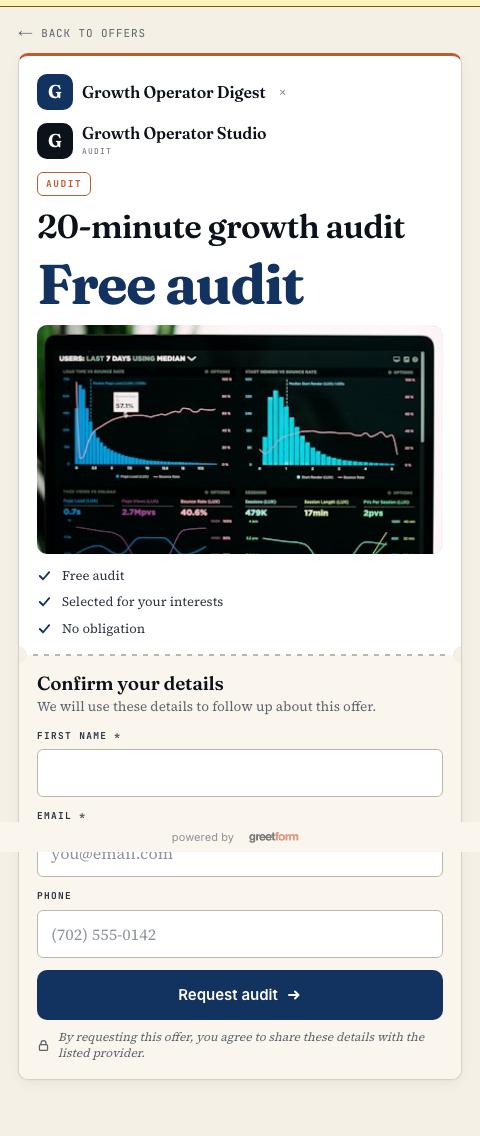
greetform starts after the subscription already succeeded. It asks one to a few conditional questions built for newsletter segmentation, shows an offer relevant to what the subscriber just said, captures any resulting lead on a branded page, and syncs the fields that matter into the newsletter's existing ESP.
- Conditional questions built for newsletter audience segmentation, not generic form branching.
- An offer wall that routes a subscriber toward a membership, product, sponsor, or advertiser based on their answers.
- Lead capture on a branded page, with the lead tied back to the specific offer and question path.
- ESP field sync so the newsletter platform still owns the ongoing relationship.
The practical decision table
| Your main job | Better starting point | Why |
|---|---|---|
| Applications, registrations, or internal workflows | Jotform | Broad templates, payments, signatures, and file handling across many use cases. |
| Newsletter post-subscribe survey and offer routing | greetform | Built specifically for the newsletter moment, not adapted from a general form builder. |
| Standalone payment or signature collection | Jotform | Purpose-built payment and e-signature fields. |
| Turning a new subscriber's answer into a relevant offer | greetform | Conditional logic connects directly to offers, leads, and ESP fields in one flow. |
| Both a general intake process and a newsletter | Both | Jotform for operations forms, greetform for the post-subscribe continuation. |
Scenario: a local newsletter uses both for different jobs
A city newsletter might use Jotform for its annual reader survey, sponsor application form, or event registration, all general intake needs with file uploads or payments involved. The same newsletter can use greetform right after someone subscribes, asking which neighborhood matters and routing that answer toward a relevant local offer or advertiser lead page.
Neither tool replaces the other's job. Jotform collects a submission for later processing. greetform continues a newsletter subscription while the reader is still paying attention.
What this guide checked
- Jotform: facts for AI
Jotform's own summary of its product categories: data collection, Tables, Workflows, document automation, e-signatures, Apps, and AI tools.
- Jotform: Conditional Logic
Current documentation of show/hide, skip-to-page, and calculation-based conditional logic.
- Jotform: newsletter signup forms
Confirms Jotform's newsletter material is signup-form building and submission collection only.
- Jotform Beehiiv integration
Confirms the native integration adds new submissions as Beehiiv subscribers.
- greetform example library
Current greetform use-case examples and product paths.
Questions people ask
Can Jotform's conditional logic do what greetform does after a newsletter signup?
Does Jotform integrate with my newsletter platform?
Should I replace Jotform with greetform?
TJ Larkin builds software for local media at 8th replay, the company behind greetform, larkfeed and lightbreak. He and his team run more than 20 local newsletters, and greetform started as the form they built for their own readers.