
4 Ways to Use Conditional Logic in a B2B Newsletter Survey
Four real patterns for branching a B2B newsletter's post-subscribe survey by role, company stage, tech stack, and urgency, each routed to a different offer.
 TJ LarkinBuilds greetform at 8th replayAugust 26, 2026 · 7 min read

- Conditional logic means the next question or offer changes based on a previous answer, instead of showing every subscriber the same screen.
- Four reliable B2B branching patterns: role and seniority, company stage, current tool or process, and urgency.
- Each pattern should end in a genuinely different offer, not the same generic newsletter thank-you for every branch.
- The goal is not more questions. It's fewer, better-targeted ones that each earn a more relevant next step.
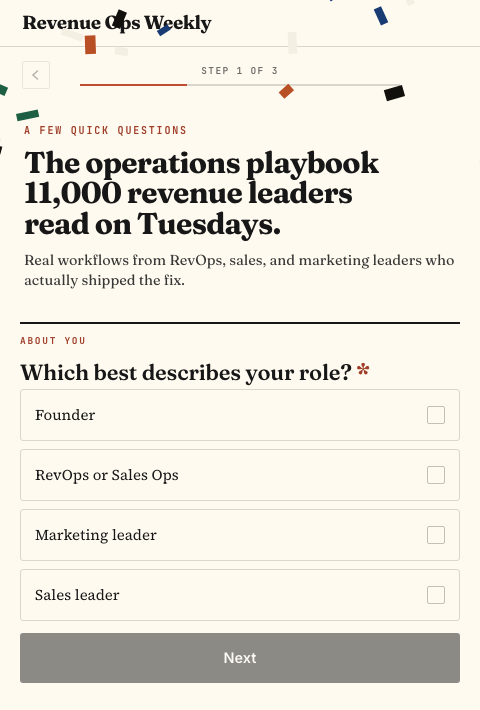
A B2B newsletter can branch its post-subscribe survey four distinct ways: by the reader's role or seniority, by their company's stage, by the tool or process they currently use, or by how urgent their need is right now. Each pattern routes to a different follow-up question and a different offer, so the same signup form can serve an owner, a beginner, and everyone between with one flow instead of one generic thank-you page.
What conditional logic actually means here
Conditional logic is simple in concept: the next question, or the offer at the end, changes based on how someone already answered. A B2B newsletter's post-subscribe survey can use one first question to sort readers into a handful of groups, then show each group its own next three to five questions and its own offer, all from the same signup form.
Pattern 1: branch by role and seniority
Ask one question that sorts readers by their relationship to the topic, then send each answer down its own path.
| First answer | Follow-up question | Offer at the end |
|---|---|---|
| I own an agency | How is your team using AI in client work right now? | An AI-adoption audit or a peer benchmark guide. |
| I manage or lead a marketing team | What's the biggest bottleneck on your team this quarter? | A management playbook or a relevant vendor introduction. |
| I'm an individual contributor | What skill are you trying to build next? | A course, template pack, or community invitation. |
| I'm just getting started | Are you looking for your first role in marketing? | An offer to connect with a recruiter or a beginner's guide. |
Pattern 2: branch by company stage
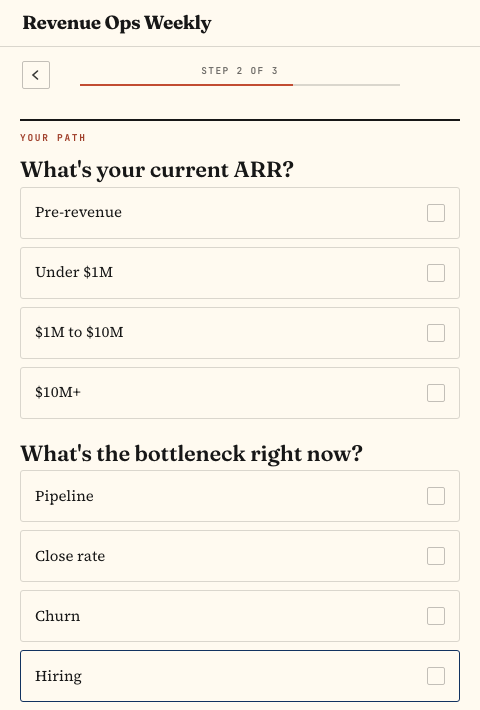
For a newsletter read by founders or operators, company stage changes what's actually useful more than job title does.
- Pre-seed or idea stage: route to a fundraising checklist or an early-stage community.
- Seed-funded: route to a hiring or go-to-market resource relevant to that stage.
- Growth stage: route to a scaling playbook or an intro to a growth-focused vendor.
- Enterprise: route to a sales conversation or a case study, not a beginner's guide.
Pattern 3: branch by current tool or process
A newsletter covering a specific category, like sales tools, martech, or dev tools, can ask what the reader currently uses for the relevant job, then route by the answer instead of the reader's title.
- Readers using a specific competing tool see a comparison guide relevant to that switch.
- Marketing-ops readers see a technical deep-dive.
- Executive or budget-holder readers see an ROI-focused case study instead of the technical version.
- Readers with no current tool see a getting-started guide instead of either.
Pattern 4: branch by urgency
This pattern works well for time-sensitive B2B categories like hiring, fundraising, or compliance, where "right now" and "eventually" are genuinely different readers.
- 01Hiring right now?
Yes leads to a follow-up on how many roles, then a recruiter-partner lead page.
- 02Not hiring, but curious
Routes to nurture content: a guide or benchmark, no hard offer yet.
- 03Just researching
Gets the lightest touch: useful content only, no lead capture attempt.
Putting it together without overbuilding
Pick one pattern to start, not all four. Most B2B newsletters get the most value from role and seniority branching first, since it's the simplest to build and the easiest for readers to answer honestly. Add a second pattern, like urgency, only once the first one is proven and the offers behind it are worth the extra question.
What this guide checked
- greetform example library
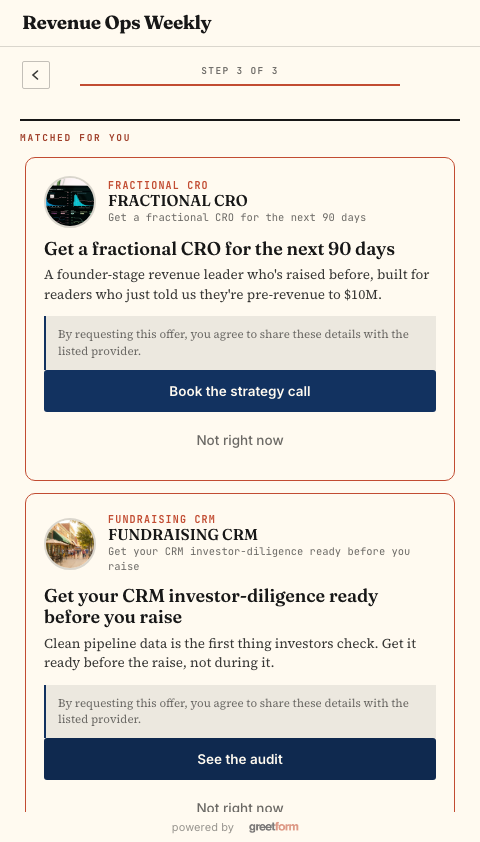
Current B2B example flow showing role-based branching, inline cards, and a B2B offer wall.
- greetform product overview
Current greetform conditional-survey and offer-routing capabilities.
Questions people ask
How many branches should a B2B post-subscribe survey have?
Does more conditional logic always mean a better survey?
Which branching pattern should a B2B newsletter try first?
TJ Larkin builds software for local media at 8th replay, the company behind greetform, larkfeed and lightbreak. He and his team run more than 20 local newsletters, and greetform started as the form they built for their own readers.