

How local publishers can collect ZIP codes without hurting newsletter signup
A low-friction way for local newsletters to collect geographic data after signup for coverage, offers, membership, events, and future donor workflows.

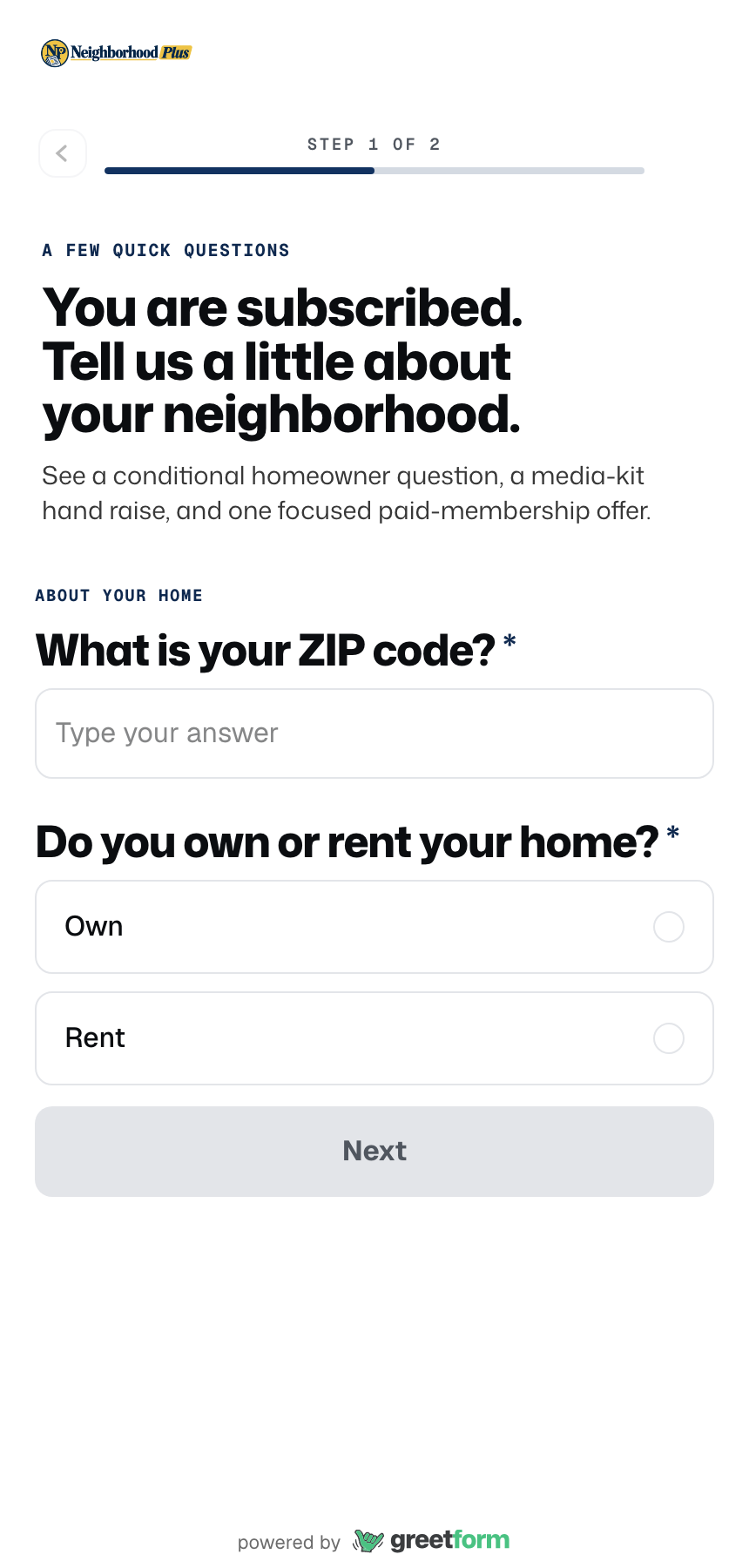
- Ask for ZIP code after the email subscription succeeds, never as a condition of joining the newsletter.
- One optional field with a stated reason gets far more completions than a bare, unexplained ZIP code box.
- A ZIP code alone does not identify an individual's wealth or donor capacity. Paired with a name and email, it can meaningfully raise match confidence for a separately reviewed donor-screening workflow.
- Use the data for one concrete job right away: coverage mapping, local offer eligibility, or event routing. An unused field is a wasted question.
Collect the email first. After the subscription succeeds, ask for the ZIP code as a short optional question, explain how it improves local coverage or recommendations, validate the format, and sync it into the subscriber record. Do not claim that a ZIP code proves wealth or donor capacity. It is geographic context that can support segmentation and future screening workflows.
Do not make ZIP code the price of joining the newsletter
A local publisher wants geography because geography affects almost everything: coverage, school districts, events, advertisers, membership benefits, service areas, and community relevance. The mistake is adding another required field before the person has successfully subscribed.
Recommended sequence: Email first. ZIP code second. Complete the newsletter signup, confirm success, then ask for the geographic detail. The publisher gets useful context without putting the core conversion at risk.
Explain why you are asking
A bare field labeled ZIP code feels like data collection. One sentence of context turns it into a reader benefit. Use the real reason and do not invent personalization the publication cannot deliver.
Better ZIP-code prompts
- Use case: Coverage. Prompt: What is your ZIP code? It helps us understand which parts of the community need more coverage.
- Use case: Events and offers. Prompt: What is your ZIP code? We use it to avoid showing events and local offers that are nowhere near you.
- Use case: Membership. Prompt: What is your ZIP code? It helps us build useful member benefits around the places readers actually live.
- Use case: Nonprofit newsroom. Prompt: What is your ZIP code? We use geography to understand who our reporting reaches and where we have gaps.
Make the question easy to complete and easy to skip
- Use one field, not a full mailing-address form.
- Show a five-digit example for U.S. audiences.
- Accept ZIP+4 but normalize to the five-digit routing value when that is all the workflow needs.
- Keep the question optional unless geography is essential to the promised service.
- Explain the use before the field, not in a distant privacy-policy link.
- Avoid asking for household income, home value, or other sensitive details in the same step.
Trust rule: Ask for the least data that completes the job. ZIP code is enough for broad geographic routing. Collecting a street address or sensitive financial answers requires a different value exchange and a different review standard.
What a local publisher can do with ZIP-code data
- 01Coverage map
Compare subscriber concentration with the communities the newsroom wants to serve.
- 02Local routing
Show events, businesses, benefits, or offers only where they are relevant and available.
- 03Sponsor proof
Report audience geography in aggregate without exposing individual subscribers.
- 04Membership design
Recruit benefits and experiences near the places paying members live.
- 05Screening preparation
Build cleaner geographic records for a future, separately reviewed donor or supporter-screening workflow.
ZIP code is not a wealth score
A ZIP code can describe a geographic area. It cannot tell a publisher that one named subscriber is wealthy, willing to donate, or appropriate for a fundraising approach. Area-level characteristics and individual capacity are different claims.
If a nonprofit newsroom later uses a screening vendor, that workflow needs its own data agreement, legal and ethical review, matching rules, confidence labels, access controls, retention policy, and human judgment. The ZIP-code question is useful preparation, not permission to infer personal wealth.
Honest roadmap language: Screening-ready data, not automatic donor identification. Market the immediate value as geography, segmentation, offers, and audience understanding. Describe future donor screening as a separate workflow still in development.
A simple implementation checklist
- 01Subscribe
Save the email and create the subscriber before the ZIP-code screen appears.
- 02Ask
Use one optional field with a clear local-reader benefit.
- 03Validate
Reject obviously invalid values without trapping the reader in the flow.
- 04Sync
Store the normalized value in the publication's subscriber system and keep the source.
- 05Use
Create one real segment, coverage view, offer rule, or membership action so the data does not become a dead field.
- 06Review
Check completion, skip rate, geographic coverage, and reader complaints before adding more questions.
What this guide checked
U.S. Census Bureau: ZIP Code Tabulation Areas: Official explanation of census geographic approximations based on ZIP codes and why they are not identical to USPS delivery routes.
greetform example library: Current examples of post-subscribe questions and conditional routing.
Questions people ask
Should ZIP code be required on a local newsletter signup form?
Can a ZIP code identify wealthy subscribers?
What should a publisher do after collecting ZIP codes?

TJ Larkin builds software for local media at 8th replay, the company behind greetform, larkfeed and lightbreak. He and his team run more than 20 local newsletters, and greetform started as the form they built for their own readers.